
Xenodot ecosystem · open source · MIT

Deliberate
pipelines, not a
chat box.

Two agent frameworks on the Claude Code SDK that build on Godot. They move the design decision before inference, not during it: an interview locks scope, a builder implements exactly that, and nothing is called done until it passes real engine gates.

Runtime
Claude Code SDK
Target
Godot · Redot · Blazium
Frameworks
Forge & Twin
License
MIT
GEN 4.x
HIVE OPUS
GATE PASS
The Xenodot emblem: a bio-mechanical alien construct with mechanical tentacles
Specimen Ø · Xenodot bio-mechanical construct

The shared bet

Push-back is the product.

Most AI game and simulation setups hand you a frontier model and a blank prompt. Describe it, paste the code, pray it runs. Xenodot refuses to silently fill a vague brief. You go through a structured interview that cuts scope to one buildable slice, produces a locked design doc, and only then hands off to a builder. The model stops guessing. You stay the designer.

Signal path · idea to running artifact gates over vibes
01 / IDEA
You
A rough intent, nothing locked yet.
02 / DESIGN
Architect
Interviews you, refuses vague scope, writes a one-page doc.
03 / BUILD
Builder
Implements exactly that doc. Nothing more, nothing less.
04 / VERIFY
Gates
Headless engine checks catch what Godot silently drops.
05 / JUDGE
You
One look in the running artifact. That is your job.
P.01

Move design before inference

Decisions get locked in a doc first. The builder never guesses its way through an ambiguous brief.

P.02

Gates, not vibes

Render health, join coverage, frame budget, playback determinism. Deterministic checks run before anything is called done.

P.03

Human in the loop

Every provider, model, and orchestrator is swappable. The approval gates and the designer interview are not.

P.04

Yours to change

Skills and rules are files. The agents trace friction and rewrite them, so the framework you end up with is not the one you started with.

Two specimens · one spine

The same pipeline, two worlds.

Twin is a fork of Forge: the same web UI, agent spine, and Godot tooling, focused down to one domain and kept in sync upstream.

Specimen 001 Domain · Games Proof of concept

Xenodot Forge Break it. Rebuild it. Make it yours.

An experiment in building games on Godot with Claude Code. Most frameworks hand you a fixed toolbox; this one is designed to be broken, rebuilt, and replaced by you. The bug-triage, skill-researcher, and godot-refactor agents close the loop: find the friction, trace the root cause, rewrite the skills.

48Skills
20Agents
4.xGodot family
FPSPOC shipped
idea game-designer godot-dev godot-verify you
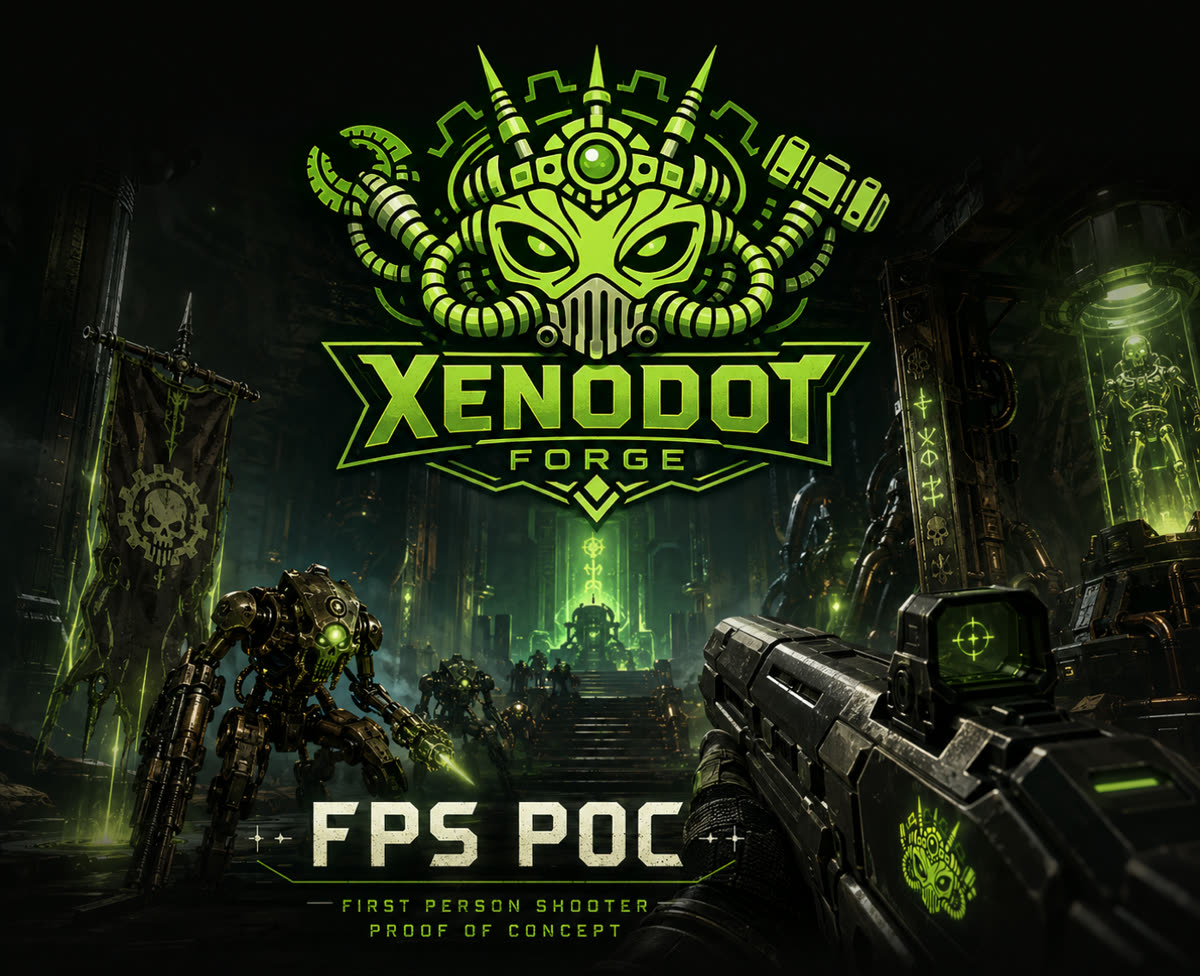
First-person shooter proof of concept built with Xenodot Forge in Godot
Evidence · FPS POC Godot 4.x
Specimen 002 Domain · Digital twins Proof of concept

Xenodot Twin A building you can walk, in real data.

Takes a real building model (IFC/BIM or CAD), imports it into a Godot 3D scene, joins it to your master data by element id, and drives it with live time-series and recorded-history playback. Honest about scope: this is visualization, geometry plus live data plus history. Not a physics or process simulator.

4.4× Optimize 27.3 to 119.4 fps on 114,400 mesh instances.
100% Join coverage IFC GlobalId carried to every mesh node.
~1.1s Import 2.3 MB IFC to GLB plus a property sidecar.
sha Gated playback Recorded history replays to an identical hash.

Measured on one machine (M3 Pro, Godot 4.6.3). Recipes generalize; percentages do not automatically.

idea twin-architect twin-import scene-optimizer data-binder you
Construct · 16 skills · 10 agents BIM / IFC

How it holds together

A conductor, not a competitor.

Xenodot does not try to beat Claude Code or any model provider. It composes them under one honest, human-gated loop, and you keep holding the wheel.

  • HIVE

    The orchestrator that never implements

    A coordination loop routes work to sub-agents, designer, builders, playtester, researchers, with named anti-patterns and a rule that the judge is never the fixer.

  • GATES

    Verification is mandatory

    Godot exits zero on parse errors and silently drops unknown scene properties. One shared check library feeds both the builder floor and the evaluator rubric, so they cannot drift apart.

  • UI

    Run the whole team from a browser

    A Node web UI streams agent activity, renders designer questions as clickable forms, turns tool approvals into allow/deny buttons, and holds a persistent task board.

  • BYO

    Bring your own provider

    The Hive drives Claude Code through the Agent SDK, so Bedrock, Vertex, and enterprise gateways are first-class. You are tied to an API shape, not a vendor.

The architect

Arthur Nunes

I design agentic systems that stay honest under pressure: pipelines that push back on vague scope, deterministic gates that refuse to call things done, and human approval kept in the loop by construction. Xenodot is the ecosystem where I work those ideas out in the open, on real engines, with real numbers.

  • A1 Multi-agent orchestration. Routing, judge-not-fixer loops, and bounded regrade cycles.
  • A2 Deterministic verification. Gate libraries a generator and an evaluator cannot drift apart.
  • A3 Framework design. Self-improving skill systems that stay files you can read and rewrite.
  • A4 Real-time 3D on Godot. BIM import, master-data joins, measured LOD and instancing budgets.